⚡ Key Highlights & Quick Takeaways
- It was also proposed to lay a fresh top layer of asphalt along the full carriageway on either side of the median to ensure a uniform riding surface.
- Thermoplastic road markings and installation of reflective road studs for improved traffic safety and riding comfort would also be added to the affected roads.
The Kerala High Court was informed that the Finance department has decided to sanction ₹10 Crore to the Kochi Corporation for rectification work required on the 3.10-km stretch of Sahodaran Ayyappan (S.A.) from the Vytila metro station to Manorama Junction.
The department said it would release the amount once the Corporation completed the procedural formalities to commence the rectification work.
The Division Bench of Chief Justice Soumen Sen and Justice V.M. Syam Kumar directed Corporation to file a report detailing the steps taken to commence the work by September 16.
The public interest litigation filed by Pauly Vadakkan, a resident of Kadavanthra, raised concerns over the hazardous road conditions along metro corridors owing to sinking of road surfaces near metro pile caps, which had reportedly resulted in accidents and loss of lives.
The court had directed the State to immediately identify, level, and permanently rectify all road surface protrusions and uneven portions surrounding metro pillars within the city. Installation of effective safety measures such as high-visibility warning signage, reflective road markers, rumble strips, and impact-absorbing protective installations around metro pillars at all identified hazardous locations was also ordered.
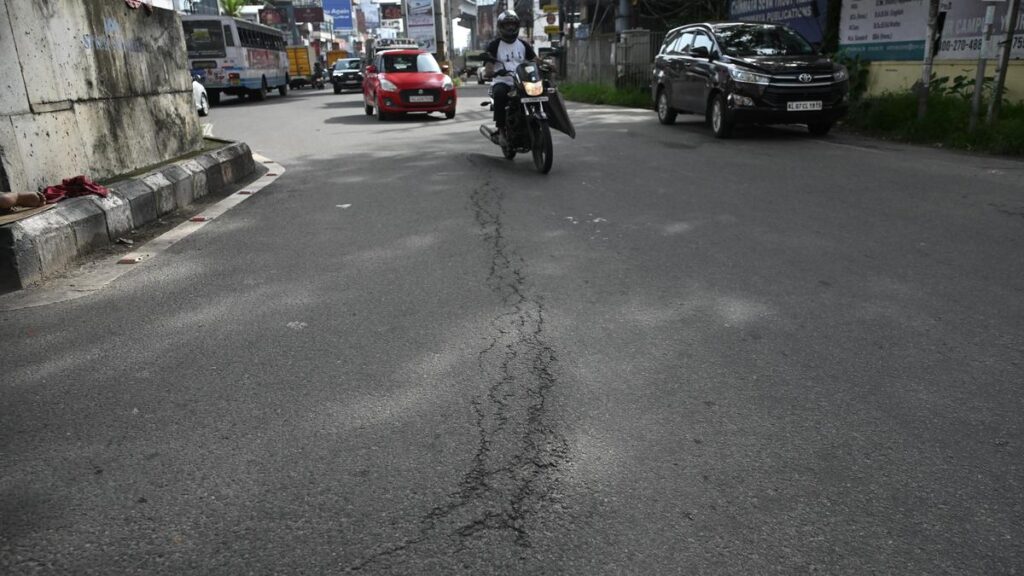
An expert committee constituted by the Corporation had conducted a safety audit along the metro rail corridor had reported that the undulations on the roads were caused by settlement of the carriageway. The committee had observed level differences of up to 300 mm at certain locations along Sahodaran Ayyappan Road, adversely affecting riding quality and traffic safety.
Subsequently, an estimate of ₹10 crore was prepared according to the Ministry of Road Transport and Highways Specifications and the standard rates, including GST compensation, contractor’s profit, and overheads for the proposed rectifications.
The work would involve scraping old asphalt, filling in low spots, levelling uneven ground, and laying fresh layers of asphalt for structure and evenness. It was also proposed to lay a fresh top layer of asphalt along the full carriageway on either side of the median to ensure a uniform riding surface. Thermoplastic road markings and installation of reflective road studs for improved traffic safety and riding comfort would also be added to the affected roads.