Updated – November 09, 2026 10:47 pm IST – New Delhi
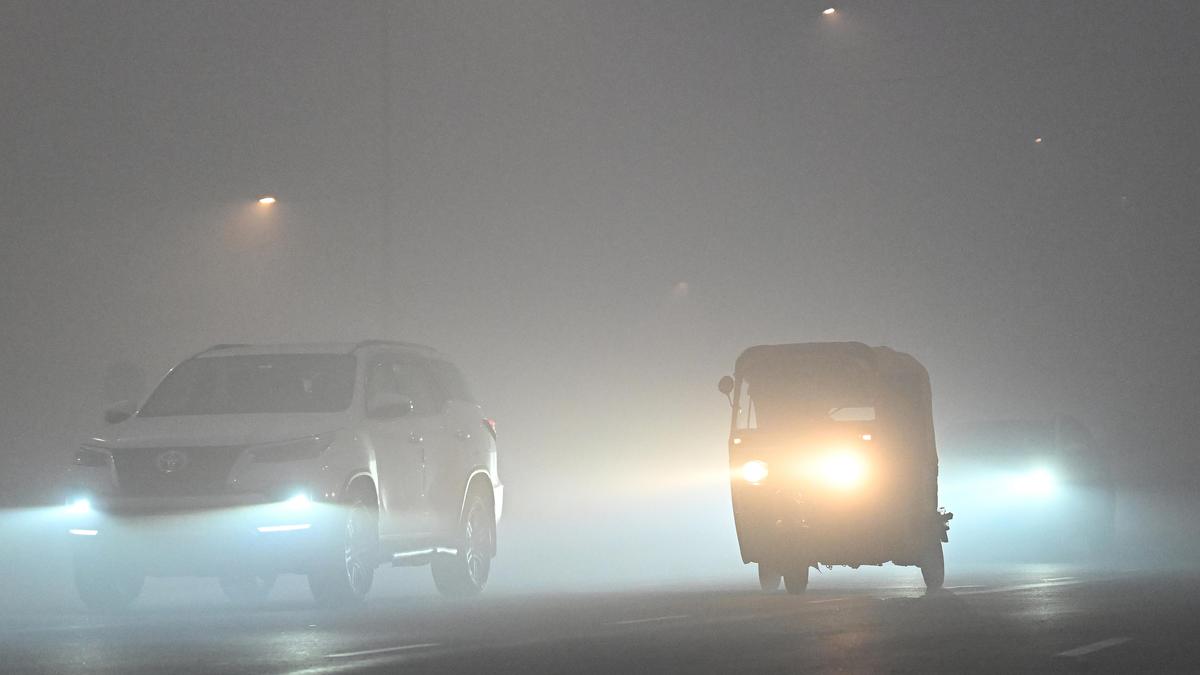
People commute shrouded in thick smog during early morning hours after Deepavali night in New Delhi on November 09, 2026.
| Photo Credit: Shashi Shekhar Kashyap
As Delhiites burst firecrackers well past the 10 p.m. deadline set by the Supreme Court for Deepavali night, air pollution shot up to over 150-200 times World Health Organisation (WHO) limits in parts of the city, but fell through the early morning hours of Monday (November 9, 2026) due to better weather conditions, show official data.
At the peak of pollution, following the bursting of firecrackers on Sunday night (November 8), crucial air quality data were missing from several monitoring stations managed by government authorities. Experts say missing data on peak values of air pollution will artificially show better air quality than the reality.
Though the Supreme Court allowed only green firecrackers during fixed windows on November 7 and 8, traditional firecrackers, which are more polluting, were also available in the markets of Delhi.
As per the Delhi government’s Delhi Pollution Control Committee (DPCC) data, the level of PM2.5 (a major pollution) in Patparganj of East Delhi was 2,597 micrograms per cubic metre at 1 a.m. on Monday — about 173.13 times the WHO permissible limit of 15 micrograms per cubic metre for a 24-hour period.
Similarly, the level of PM2.5 in NSUT West Campus was 3,008.4 micrograms per cubic metre at 5 a.m. on Monday (November 9) — about 200.5 times the WHO permissible limit. PM2.5 (Particulate matter 2.5) are fine inhalable particles, which can get into lungs and bloodstream and lead to a range of respiratory and other diseases.
Gufran Beig, chair professor, National Institute of Advanced Studies, said though the air pollution spiked around 12 midnight on Sunday (November 8) to 5 a.m. on Monday (November 9) due to bursting of firecrackers on Deepavali, both wind direction and speed were very favourable for faster dispersion of air pollution.
“The wind direction was earlier north westerly, originating from stubble burning areas in Punjab and Haryana. But around Sunday afternoon, it changed to easterly and south easterly and also picked up speed by Sunday evening. The reversal of wind direction led to almost negligible effect of stubble burning in Delhi,” said Mr. Beig, who is also the founder-director of the Central government’s SAFAR (System of Air Quality and Weather Forecasting Research).
Hourly PM2.5 concentrations across Delhi.
| Photo Credit:
CPCB CAAQMS
The 24-hour average overall Air Quality Index (AQI) of Delhi stood at 344 (“very poor”) at 4 p.m. on Monday (November 9), lower than 376 (“very poor”) a day earlier, according to the CPCB’s daily bulletin, which is considered the day’s AQI. A higher AQI means worsening of air quality. The overall AQI of Delhi which stood at 370 (very poor) at 9 a.m. on Monday, improved through the day to reach 344 by 4 p.m.
Meanwhile, both the AAP and the Congress attacked the BJP government over the missing data, with the former alleging that it was “data fraud”. Hitting back, Delhi Labour Minister Kapil Mishra alleged there was a “conspiracy” by AAP-governed Punjab to set stubble on fire on Sunday evening.
Every winter, air pollution spikes in Delhi-NCR and many parts of the larger Indo-Gangetic Plains, mainly due to meteorological factors such as lower wind speeds and a drop in temperature. Also, pollution from stubble burning during October and November and bursting of firecrackers during the festive season add to existing pollution from vehicles and dust, worsening the air quality.
Meanwhile, Punjab recorded 1,152 stubble burning incidents on Sunday (November 8) — the highest this paddy harvest season, according to the Indian Agricultural Research Institute’s (IARI) daily bulletin. But it dropped to 198 on Monday, taking the total this harvest season to 4,657, the second lowest since 2020 (till November 9), the data show.
The contribution of stubble burning in neighbouring States to PM2.5 (a chief pollutant) in Delhi on Sunday (November 8) was 5.1%, according to the Union Ministry of Earth Sciences data.