⚡ Key Highlights & Quick Takeaways
- Stubble burning in Punjab, Haryana | Caught in the cross (farm) fire Mr.
- Varma’s comments come in the context of mounting evidence since 2024 that the Punjab government’s claims of having reduced farm fires by 90% since 2021 were exaggerated.
- But we have asked the ISRO to give us a basic protocol this year so that we can make a beginning in getting a better estimate than fire counts,” he added.
As part of its preparation to buffer winter pollution in the Delhi national capital region, the Commission for Air Quality Management in NCR and Adjoining Areas (CAQM) said it was in discussion with authorities in Punjab and Haryana to improve measurement of stubble fires.
“While the fire counts reported from satellite passes may not be the most accurate picture of the extent of farm fires, we are in talks with the Indian Space Research Organisation (ISRO) as well as Punjab to have better ‘ground truthing’ protocols,” Rajesh Varma, Chairman, CAQM said at a press briefing on Thursday (September 3, 2026).
Fire count gives a skewed picture of stubble burning: study
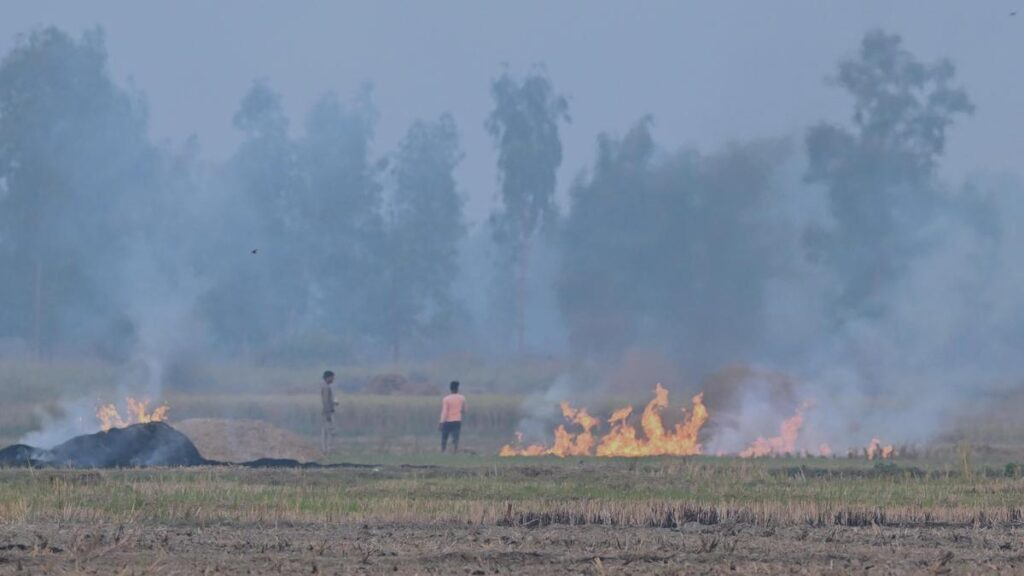
Farm fires in Punjab are a major contributor to pollution during some weeks of October and November when monsoon withdrawal stalls westerly winds that flush out particulate matter pollution from vehicles, industry, road dust, agriculture waste and in the run-up to Deepavali, crackers.
In this period, paddy stubble left over after harvesting is frequently burnt to make way for sowing wheat, it being the most economical and quickest dispensation method. Over a whole winter, farm fires contribute no more than 15% of the particulate matter pollution but on certain weeks, this share can spike to almost 44%, several studies have shown.
Stubble burning in Punjab, Haryana | Caught in the cross (farm) fire
Mr. Varma’s comments come in the context of mounting evidence since 2024 that the Punjab government’s claims of having reduced farm fires by 90% since 2021 were exaggerated. This is because these were counted through tracking fires via two satellites passing over India during the day and encouraging several farmers, who otherwise face the prospect of fines for being caught setting fire to their fields, to burn stubble in the evenings. An ISRO Space Applications Centre study found a gradual shift in peak fire activity from 1.30 p.m. in 2020 to around 5 p.m. in 2024, to avoid detection by polar-orbiting satellites.
Stubble burning in Punjab, Haryana contributes only 14% of PM2.5 in Delhi-NCR: study
In 2025, iForest, a research outfit used data from a different satellite to compute another parameter called ‘burnt area,’ — the actual land area affected by fire — and found that the reduction was more gradual, around 30%, falling from about 31,500 sq km in 2022 to 19,700 sq km in 2025.
Mr. Varma stressed that defining a protocol was “complicated” in that while burnt area could give a better estimate of singed acreage, it was not always an accurate measure of the extent of particulate matter emitted from burning. “The resolution of the satellite sensors matters and the pollution level depends on straw quantity, moisture, combustion efficiency and per-pollutant emission factors which satellites can’t measure. But we have asked the ISRO to give us a basic protocol this year so that we can make a beginning in getting a better estimate than fire counts,” he added.