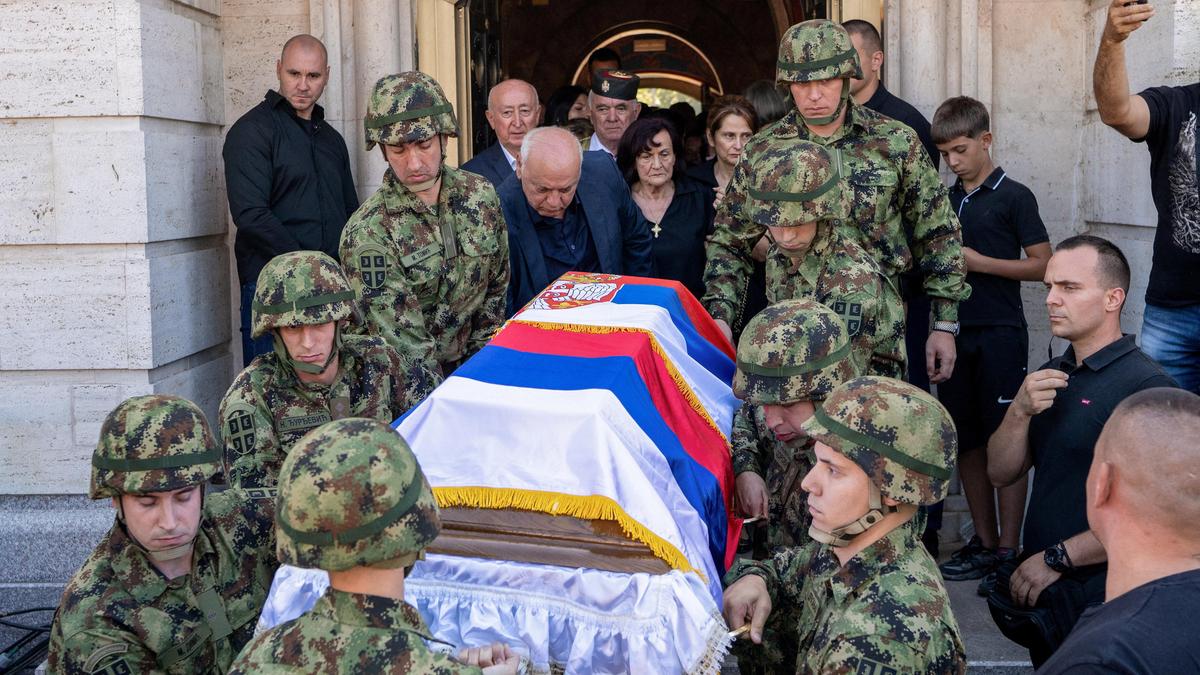
Thousands of people gathered in Belgrade on Monday (September) for the funeral of the former Bosnian Serb General Ratko Mladic, who died last week while serving a life sentence for genocide, war crimes and crimes against humanity.
‘Butcher of Bosnia’ Ratko Mladic dead: Serbian state media
Crowds carrying Serbian flags and pictures of Mladic wearing a traditional Serbian military cap gathered outside the church in a Belgrade suburb where the head of the country’s Orthodox church, Serbian Patriarch Porfirije, presided over the service.
Mladic’s coffin, surrounded by armed soldiers in fatigues and accompanied by a brass band, was then paraded through streets thronged with onlookers, who chanted his name. He was buried at a nearby cemetery next to his daughter, who died in 1994.
Also read | Judges uphold conviction of Serb military chief Ratko Mladic
It was one of the biggest public funerals in Serbia since the fall of communism in 1990 and showed how revered Mladic remains among many in Serbia and in Bosnia’s autonomous Serb Republic, despite his convictions linked to his role in the 1995 Srebrenica massacre and in the siege of Sarajevo — two of the bloodiest events in post-war Europe.
“He is a hero,” Djordje, a 34-year-old man who came from Prijepolje to pay respects to Mladic, said. “He was a great military strategist.”
CONFLICTS TRIGGERED BY BREAK-UP OF YUGOSLAVIA
Mladic’s death has stirred up strong feelings linking back to the break-up of Yugoslavia and the ethnic conflicts that ensued in the Balkans.
Mladic was found guilty by the United Nations International Criminal Tribunal for the former Yugoslavia of genocide for his role in the 1995 Srebrenica massacre, in which about 8,000 Bosniak Muslim men and boys were killed after Bosnian Serb forces overran the UN-designated enclave.
He was also convicted over the 43-month siege of Sarajevo, during which about 10,000 people were killed.
Last week, EU enlargement commissioner Marta Kos postponed her visit to Serbia, which is a candidate country to join the bloc, because of what she said was the “glorification” of Mladic after his death, including the use of a government plane to return him to Serbia.
“The Western Balkan armed conflicts of the 1990s were among Europe’s darkest moments in its recent history,” an EU spokesperson said in a statement on Monday (September 7).
“Any glorification of war criminals, genocide denial and revisionism contradict the most fundamental European values and have no place in the EU or in EU candidate countries.”
Serbian President Aleksandar Vucic, who dismissed Kos’ statement last week, did not attend the funeral. However, his son Danilo attended, along with Defence Minister Bratislav Gasic and Justice Minister Nenad Vujic.
PAINFUL REMINDER FOR THOUSANDS
In Sarajevo, meanwhile, the funeral rekindled painful memories of the war. Telecom companies in Bosnia’s Bosniak-Croat federation blocked the signal of the two Bosnian Serb TV stations that carried live broadcast of the funeral and procession.
Bosnia’s Foreign Minister Elmedin Konakovic said the country will withdraw all staff from its embassy in Belgrade except for the ambassador and consul in protest at Serbia’s handling of the funeral, including the military escort of the body and the attendance of government officials.
“It is really horrible that this is taking place there [in Belgrade] because I know there are normal people who are against it,” said Zdravka Gvozdjar, a retired pharmacist whose 9-year-old son was killed during the Sarajevo siege by a grenade fired by the Mladic-led forces, one among more than 1,000 children killed in the city.
“Mladic … only deserved to be erased from memory for good, not to be … promoted as a hero,” she said. “He should be remembered only as a butcher.”