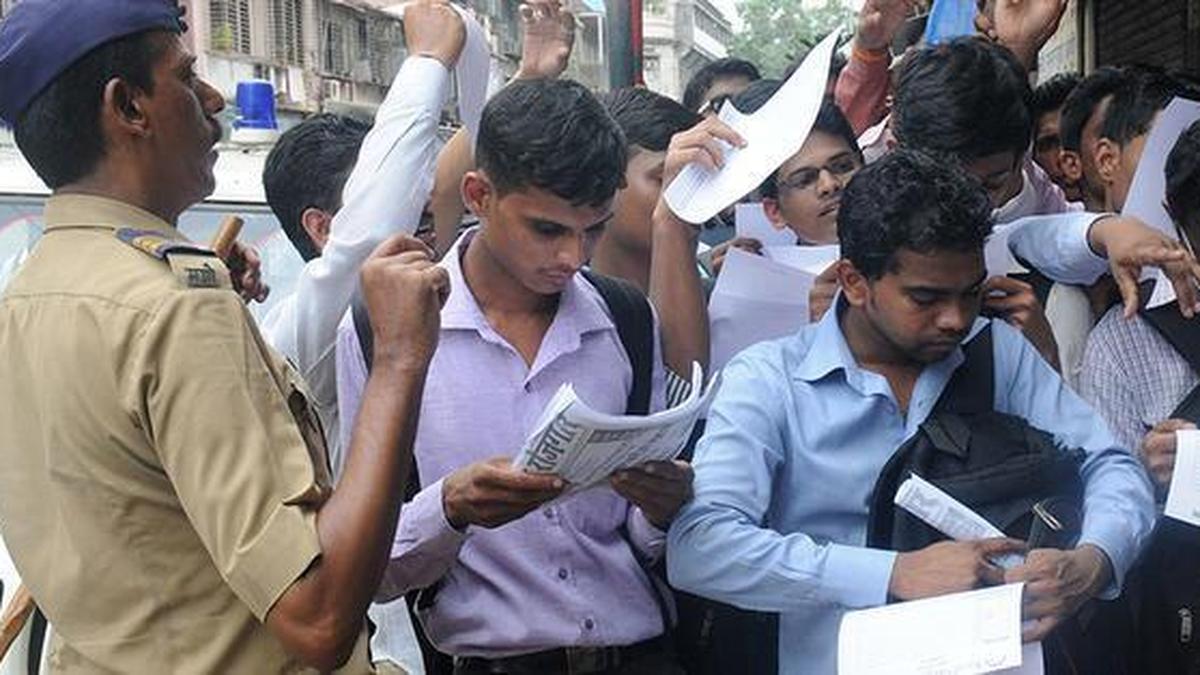
The five-week Gen Z sit-in at Jantar Mantar has prompted a remarkable series of government responses: a change at the helm of the Union Education Ministry, a task force under Nandan Nilekani to reform the examination system, and a direct assurance from Prime Minister Modi that those who tamper with exams will face tougher punishment.
For the protesters, examination integrity is important but insufficient. Even a perfectly functioning examination system can only determine who gets through the gate. It cannot answer the more fundamental question: what awaits India’s young people once they do? The root cause is the lack of an institutional response to create enough productive, remunerative and aspirational jobs for India’s growing pool of young people.
The scale of the problem is stark. The Economic Survey 2023–24 estimated India needs nearly 78.5 lakh new non-farm jobs a year until 2030 — roughly one every four seconds. The State of Working India 2026 report by Azim Premji University puts India’s youth population (15–29) at 36.7 crore, of whom 26.3 crore sit outside education as the potential workforce. With a median age of 28, India has a powerful but time-bound demographic advantage.
The mismatch between education and employment is now routine news. The media widely reported that in Rajasthan in 2025, nearly 24.76 lakh people applied for under 53,759 peon posts, many of them graduates and postgraduates. This isn’t about the dignity of the work — it shows that when millions of increasingly qualified young people chase a tiny pool of secure jobs, a single government post takes on disproportionate value. That is fertile ground for exam malpractice. Overqualification doesn’t cause leaks; extreme competition for scarce, secure employment does.
India’s IT and IT-enabled services sector has been a major employment engine — NASSCOM puts direct employment at about 59.5 lakh for FY2025–26 — but it added only about 1.35 lakh net jobs that year as AI-led delivery and automation take hold. Technology alone cannot absorb the millions entering the workforce annually. Manufacturing and other labour-intensive sectors have far greater potential to absorb workers across the full range of education and skill levels. India needs an economic strategy that creates demand for labour at scale, not merely a skilling strategy for jobs that don’t yet exist.
The India Employment Report 2024 notes that educated youth increasingly aspire to stable white-collar work as their education rises. This isn’t a hesitation to work in agriculture or construction — it’s a rational calculation: What will I earn? Will my income rise? Can I move up? Unemployment persists among graduates and school-leavers alike, so growth has to be inclusive at both the bottom and top of the wage and skill distribution — and jobs at the bottom must offer a pathway upwards, not stay there permanently.
India’s skilling schemes have underperformed for years: under Pradhan Mantri Kaushal Vikas Yojana (PM-KVY), only 19.1 lakh of 27.3 lakh enrolled beneficiaries were certified over the past three years, and funding has been substantially underutilised. Under Deen Dayal Upadhyaya Grameen Kaushalya Yojana (DDU-GKY), 18.45 lakh rural youth have been trained, but only 12.35 lakh have been placed, often into jobs paying as little as ₹6,000 a month — barely enough once the cost of migrating for work is factored in. Certification without jobs is meaningless, and jobs without adequate wages are unattractive.
Part of the problem is structural, and it points to a fix worth borrowing. The U.S. and Singapore run workforce development boards — district-level bodies where industry, academia and government sit together to forecast actual local demand: how many carpenters, how many mechanical engineers, in which district, over what horizon. India’s skilling effort, by contrast, is largely supply-led: training happens where the people are, not where the jobs are. That forces skilled workers to migrate in search of work, or leaves skilling wasted when local industry can’t absorb what’s been trained. A district-level, tripartite forecasting mechanism — matching skilling output to real, located industrial demand — would let India skill for jobs that actually exist nearby, rather than training first and hoping employment follows.
The protesting students can rightly celebrate winning a battle over the integrity of examinations. But government now needs to get into the business of creating jobs at the pace India’s youth are getting ready to take them. The battle for education is about getting young Indians through the gate. The war for jobs is about ensuring there’s somewhere worthwhile for them to go.
This is where the political leadership – government and opposition alike – needs to change register. Skilling and job creation are a national responsibility, not a partisan scorecard. It is easy for the Opposition to point out that enough jobs aren’t being created; it is harder, and far more useful, to sit across the table and help solve it. India’s youth don’t need a debate about who is to blame for the jobs gap. They need the government and the Opposition working together, with the same urgency they showed on examination reform, to close it.
(Chocko Valliappa is Founder and Managing Director of Technology and IT services company Vee Technologies and Vice Chairman of Sona Group of Education Institutions, Salem.)