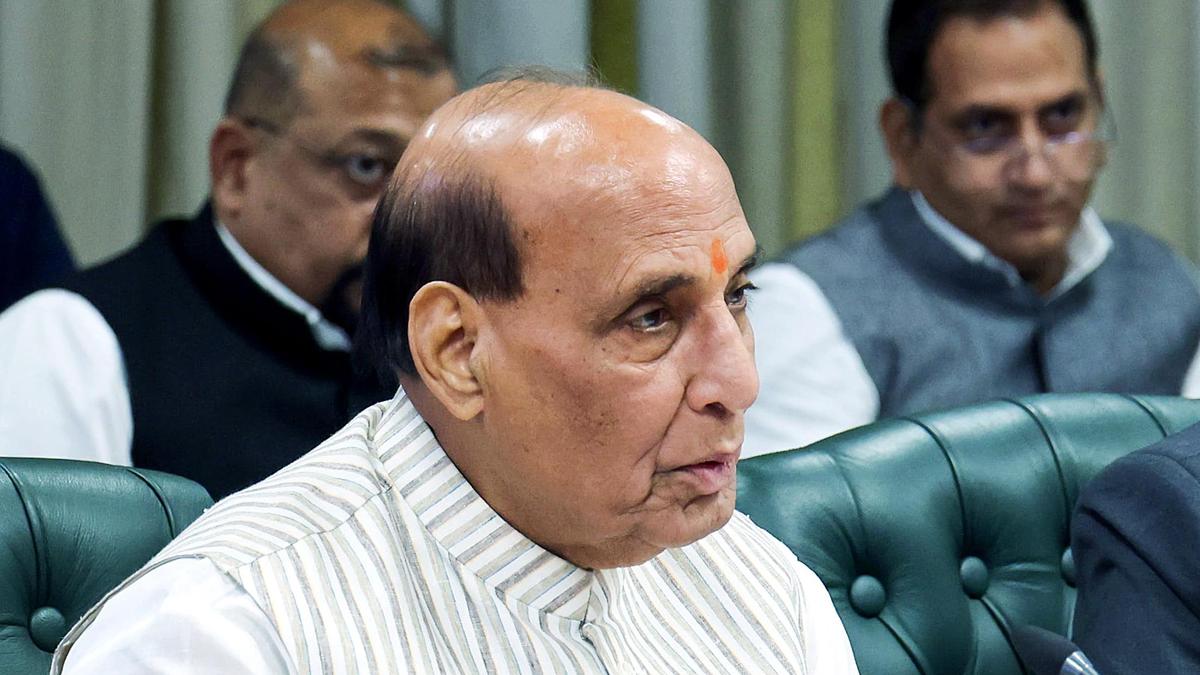
The Defence Acquisition Council (DAC), chaired by Defence Minister Rajnath Singh, on Monday (September 7, 2026) accorded Acceptance of Necessity (AoN) for a range of acquisition proposals for the armed forces estimated at ₹1.10 lakh crore, with approximately 98% of the procurements planned to be from Indian industry.
According to the Defence Ministry, for the Army, the DAC approved the procurement of chemical, biological, radiological and nuclear (CBRN) reconnaissance vehicles, high mobility vehicles (HMVs), self-propelled mechanical mine layers (MMLs), advanced light helicopters (ALHs), trawl tanks and the Sarvatra Bridge System.
The CBRN reconnaissance vehicles will be capable of detecting, identifying, monitoring and marking areas contaminated by chemical, biological, radiological and nuclear agents. The HMVs are expected to strengthen operational mobility and logistics support in difficult terrains, while the MMLs will provide faster and more responsive mine-laying capability during operations.
The ALHs will be used by the Army and the Air Force for complex missions across diverse terrains and operational situations. The trawl tanks and the Sarvatra Bridge System will provide composite crossing capability to fighting formations during operations in varied terrains.
Domestic defence industry to benefit
For the Navy, the DAC granted AoN for the procurement of Arudhra radars and the design, development and subsequent procurement of marine gas turbines (MGTs).
The Arudhra radars will replace existing air route surveillance radars at various naval air stations. Indigenous development of MGTs, which are crucial for warship propulsion, is expected to reduce dependence on foreign vendors.
For the Air Force, the Council approved several proposals aimed at enhancing the war-fighting capabilities of its fighters, transport aircraft and helicopters.
The DAC also cleared the procurement of ground-based multi-purpose jammers (GBMPJ), which will provide effective jamming capability against adversary radars. Approval was also accorded for the installation of the Defence Forces Secure Access Card (DEFSAC) system, which will replace existing paper-based identity cards, passes and permits with interoperable radio frequency identification(RFI)-based smart cards.
The latest approvals underline the government’s continued emphasis on strengthening military capability while pushing for defence indigenisation, with nearly the entire value of the approved acquisitions set to flow to the domestic defence industry.