⚡ Key Highlights & Quick Takeaways
- In the coming days we will raise the orbit and take it to the required orbit and place the satellite in the Geo platform for national activities,” the ISRO Chairman said.
- Kudos to Team @isro on the successful launch of GSLV-F17/EOS-05.
- However, the cryogenic upper-stage ignition did not happen due to a technical anomaly, and the mission remained unsuccessful.
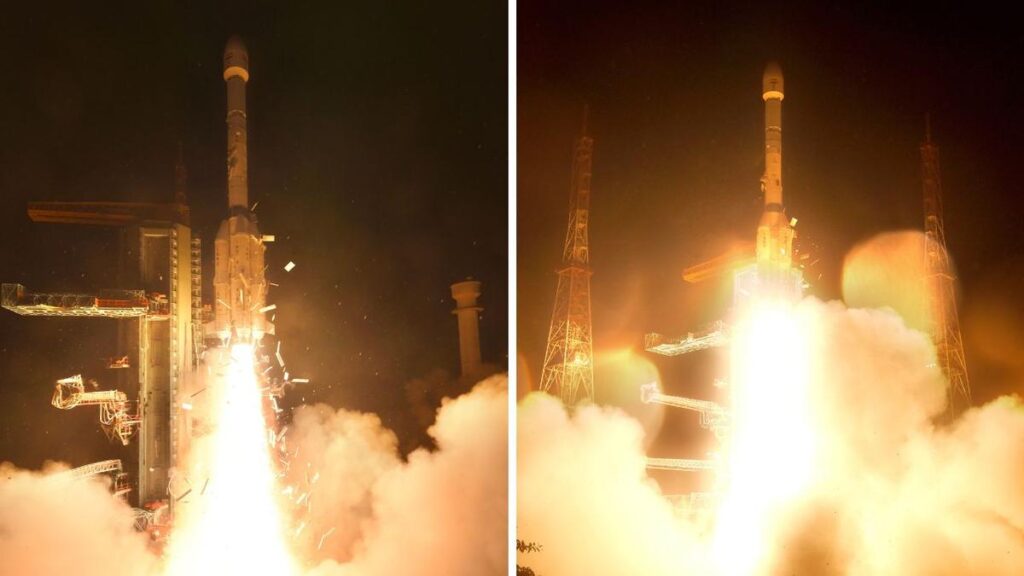
The Indian Space Research Organisation (ISRO), which has had a quiet year so far, is back to winning ways with the successful launch of the state-of-the-art Earth observation spacecraft, EOS-05.
Graphics | India’s space journey
The Geosynchronous Satellite Launch Vehicle (GSLV) on its 19th flight placed the EOS-05 into the intended Sub-Geosynchronous Transfer Orbit 18 minutes after it lifted off from the second launch pad of the Satish Dhawan Space Centre in Sriharikota at 2.55 a.m. on Thursday (September 4, 2026).
The EOS-05 is India’s first ever imaging satellite to monitor from Geosynchronous orbit about 36,000 km above the Earth.
“I am very happy to announce that the GSLV-F17 vehicle has successfully and precisely injected the advanced Earth observation satellite EOS-05 in the intended and required orbit,” ISRO Chairman Dr. V. Narayanan said.
Losing the way: On ISRO and issues with its NavIC constellation
He added that this was the 107th launch from the spaceport in Sriharikota and the 19th mission of the GSLV.
“The first launch of the GSLV-D1 was done with a payload of 1536 kg. From that, gradually we have improved the performance of this vehicle by optimising the structural mass and improving the propulsion systems, and today we have injected the heaviest satellite, a 2367 kg satellite, using this launch vehicle,” he added.
The ISRO Chairman said that once the Earth observation satellite, EOS-05, is operationalised in orbit, it will become India’s first dedicated imaging satellite from the Geo Orbit, providing important strategic data for our country.
“From the satellite data we confirm all the valves are operating perfectly, the solar panel is deployed and the health of the satellite is perfectly alright. In the coming days we will raise the orbit and take it to the required orbit and place the satellite in the Geo platform for national activities,” the ISRO Chairman said.
ISRO successfully carries out tests of Gaganyaan crew module systems
Prime Minister Narendra Modi on Friday (September 4, 2026) hailed the successful launch of the country’s first-ever imaging satellite in geo-orbit and said it was a proud moment for the country.
“Yet another outstanding achievement by ISRO and a proud moment for our nation. The successful launch of GSLV-F17 carrying EOS-05, India’s first-ever imaging satellite from Geosynchronous orbit is a reflection of the excellence, innovation and growing capabilities that define India’s space sector,” PM Modi said in a post on X.
“The growing partnership between ISRO and Indian industry is adding new strength and scale to our space programme and expanding India’s capabilities across the entire space ecosystem,” he added.
Six sluggish months later, ISRO looks to reset with satellite launches
Minister of State in the Department of Space, Jitendra Singh, wrote on X, “Another giant leap for India in Space! Kudos to Team @isro on the successful launch of GSLV-F17/EOS-05. EOS-05 is a state-of-the-art Earth Observation satellite and India’s first imaging satellite from Geosynchronous Orbit, enabling advanced imaging across visible, infrared, multi-spectral and hyperspectral bands. With the visionary leadership of PM Shri @narendramodi Ji, India’s space capabilities continue to scale new heights, strengthening our position as a global space power.”
The EOS-05 satellite dubbed ‘Eye in the Sky’ will provide real-time imagery besides helping agriculture, the environment, disaster management, and others.
The successful launch of the EOS-05 comes as a huge relief for ISRO, which has not carried out any launch activities since the failure of the PSLV-C62 mission carrying the EOS-N1 earth observation satellite on January 12, 2026.
The space agency, since the back-to-back failures of PSLV-C62 and the PSLV-C61 on May 18, 2025, had taken a cautious approach and refrained from carrying out any launches.
The state is draining ISRO’s hard-won excellence
Though seven missions, including the GSLV-F17/EOS-05, were scheduled to take place in the first quarter of 2026, ISRO did not launch any satellites.
The successful launch of the 2367 kg EOS-05 satellite also puts behind the failure which ISRO had encountered in August 2021 with the GSLV-F10 / EOS-03 mission.
Back then, the GSLV-F10 / EOS-03’s mission performance was normal during the first and second stages. However, the cryogenic upper-stage ignition did not happen due to a technical anomaly, and the mission remained unsuccessful. The EOS-05 satellite replaces the unsuccessful EOS-03 mission.
EOS-05: ISRO successfully launches India’s heaviest satellite